Data Breaches are inevitable


According to the European Commission, a data breach occurs when data under an organization's responsibility suffers a security incident that compromises its confidentiality, integrity, or availability.

Industry leaders and regulators now agree on a hard truth: on a long enough timeline, data breaches are inevitable.

The IBM Cost of a Data Breach Report 2025 confirms that breaches occur despite strong preventive controls. As digital dependency grows, attacks become more frequent, more sophisticated, and more costly.

The question is no longer if your organization will be breached—but when, and how often.

As a result, cybersecurity strategy has shifted from pure prevention to resilience: detect faster, respond quicker, recover sooner.

But resilience has a critical blind spot.
Some damages cannot be mitigated


Organizations worldwide are taking an average of 181 days to detect a breach, while attackers can exfiltrate data in as little as 72 minutes.

By the time a breach is detected, sensitive data has already been stolen.

At that point, no response plan can reverse the damage.

If a cyberattack disables critical medical devices in a hospital and patients die as a result, no mitigation strategy can undo that loss.

Death is irreversible.
Same it is Data theft.

Once attackers steal sensitive data, the damage is already done. The data is copied, retained, and exploitable indefinitely.

Stolen data cannot be un-stolen.

It does not matter how fast a breach is detected if detection happens after data exfiltration. Recovery can restore systems—but it cannot erase stolen information from the attacker’s possession.

Stolen Data Retains 100% of its Value.


Organizations and governments spend billions on cybersecurity, yet attackers still get in.

Among all forms of cyber damage, data theft is the most irreversible.

Systems can be rebuilt.
Operations can resume.
Ransomware can sometimes be avoided.

But stolen data remains fully usable.

According to the Microsoft Digital Defense Report 2025, 80% of cyberattacks in 2025 were primarily aimed at data collection.

Once attackers obtain readable data, it can be:

  Extorted and Ransomed
  Used for financial fraud
  Exploited for identity theft
  Leveraged for corporate espionage
  Long-term exploitation
  Sold on black markets
  Reused indifinetly for future attacks

Even if a ransom is paid and systems are restored, attackers still retain the stolen data. The long-tail cost of breaches often persists for years, crippling organizations—or forcing them out of business entirely.

Why current cybersecurity fails to stop data theft


Modern cybersecurity focuses on access control, not data content.

Firewalls, VPNs, authentication, Zero Trust architectures—all aim to prevent unauthorized access. But once access is gained, data is readable.

Cybersecurity cannot:

  Prevent insiders from stealing data
  Distinguish legitimate users from intruders using stolen credentials
  Protect data once it is accessed
  Neutralize stolen information

Cybersecurity protects systems.
It does not protect data itself.

This is the fundamental gap.

The problem with structured data


Most sensitive information lives in structured storage, such as databases.

Databases rely on strict field formats:

  Fixed-length numeric fields (credit cards, SSNs)
  Fixed-length alphanumeric identifiers
  Structured personal and financial records

To encrypt data inside these fields without breaking applications, encryption must preserve:

  Data type
  Data lenght

This requires Format-Preserving Encryption (FPE).

However, current encryption approaches fall short:

  Asymmetric encryption does not preserve format or length
  Most modern encryption is not quantum-resistant
  Post-quantum encryption standards are asymmetric and unsuitable for databases
  AES supports FPE only through FF1 mode
  Existing symmetric encryption is not designed for long-term quantum resistance

As IBM CEO Arvind Krishna stated in 2018:
“If somebody is saying they want something protected for at least 10 years, they should seriously consider whether they should start moving to alternate encryption techniques now.”

The industry still lacks a scalable, quantum-resistant encryption approach that can securely protect structured data without breaking systems.

Breaches cannot be fully prevented


Cybersecurity operates in an asymmetrical battlefield.

Attackers need only one weakness—human error, credential theft, insider access, supply-chain compromise. Defenders must secure everything, all the time.

This is not a failure of cybersecurity.
It is the nature of the threat landscape.

Traditional security models resemble a castle-and-moat defense: once the perimeter is breached, attackers can freely loot what’s inside.

Zero Trust improves this model by adding internal controls—but anyone with valid credentials can still access readable data.

The Financial gap keeps widening


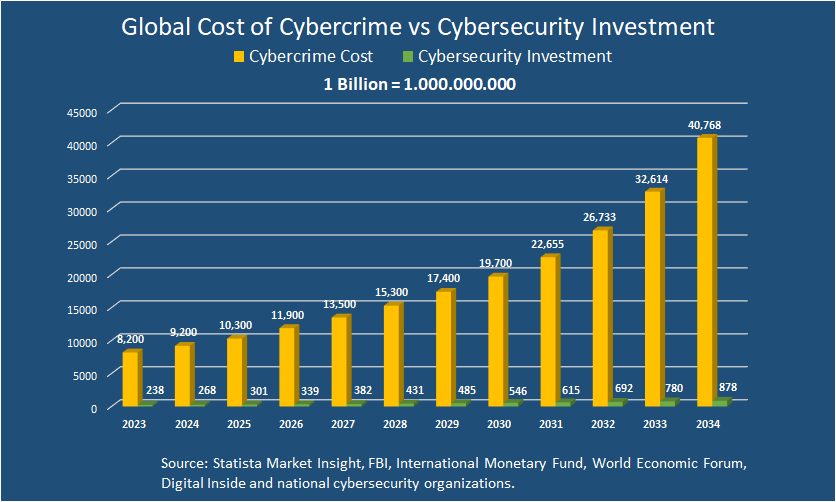
• Global cybersecurity investment (2025): ~$301B

• Global cost of cybercrime (2025): ~$10.3T

Cybercrime costs exceed cybersecurity investment by more than 34x.

Cybercrime is now the third-largest global economy, behind only the U.S. and China.

As artificial intelligence and quantum computing accelerate attacker capabilities, this gap continues to grow.

Cybercrime cost evolution

Global Cybercrime Annual Cost vs Global Cybersecurity Annual Investment - Years 2023 to 2034


The Consequences are severe


Financial Devastation:
Extortion, recovery, legal fees, and operational losses—many companies fail within six months of a major breach.

Reputational Damage:
Loss of trust leads to long-term customer attrition and brand erosion.

Operational Disruption:
Downtime halts business and impacts customers.

Legal and Regulatory Penalties:
Fines can reach up to 4% of global turnover under regulations like GDPR.

Intellectual Property Theft:
Competitive advantage is permanently lost.

Persistent Vulnerability:
Stolen credentials are resold repeatedly, enabling future attacks.

Digital Distrust:
57% of individuals affected by data misuse abandon digital services.

The core problem


Breaches are inevitable
Readable stolen data is irreversible damage

And today's cybersecurity model was never designed to stop it.